
Powered by the Younite Virtual Showroom platform
When Saxdor Yachts first launched its Digital Showroom, the goal was to give its global dealer network a better way to present and sell boats without depending on physical inventory. What started as a sales platform for dealers, evolved into a new way for consumers to discover, explore, and fall in love with a product before ever stepping aboard.
This is the story of how Saxdor extended its Digital Showroom from a dealer sales platform to a full consumer experience, and what it means for brands selling complex, configurable products.
To start with – What is Saxdor's Digital Showroom?
Saxdor's Digital Showroom is the brand's own name for its virtual product experience. Under the hood, it runs on the Younite Virtual Showroom platform – a technology designed for manufacturers of complex, configurable or made-to-order products who want to present their portfolio in an interactive, photorealistic environment. The Virtual Showroom platform caters to different touch points allowing user to access it from their available devices; no maximum spec gaming PCs required. But more about that later – first let’s talk a bit about the heart of any Virtual Showroom, the Digital Twin.
Digital Twins: the technology at the centre of it all
Every Virtual Showroom is built on a Digital Twin: a photorealistic, interactive 3D replica of a physical product. A Digital Twin isn't just a render or a CAD model. It is a live, configurable, explorable 3D model of the product that looks and behaves like the real thing: you can move around it, interact with its features, change materials and options, and see it all update in real time.
In Saxdor's case, each yacht model in the their Digital Showroom exists as a Digital Twin, accurate from the hull color and engine configuration down to the upholstery choice and optional extras such as sunshades. The high fidelity Digital Twin can be explored on consumer grade devices without specialist hardware and the way this is technically achieved differs depending on whether the Virtual Showroom touch point is directed towards business users such as dealers, or directly towards consumers.
Business Showroom: giving dealers a superpower
The first use case for Saxdor's Digital Showroom was the dealer network. Presenting a yacht range to a potential buyer has traditionally required either bringing the customer to where a boat was physically moored, shipping a vessel to a dealership, or settling for brochures and static images. None of these options is ideal when you have a broad & growing portfolio, multiple markets, and products that take a while to build.
The Digital Showroom changed this. Dealers could present every model, every configuration, in a polished and immersive environment, regardless of what stock was physically available or where the dealers were physically located. Saxdor’s dealers use the Digital Showroom with an iPad so the solution is mobile, while the quality is way beyond what these devices can produce. So how’s that possible? Younite uses pixel streaming in the Business Showroom to stream the Digital Twin render in real-time from powerful cloud computers rather than relying on the processing power of the user's device. The result is a level of visual fidelity that was previously only achievable by having a powerful device such as a gaming PC available locally, which would be quite inconvenient to carry around. So we chose iPads instead.
Within its first months of operation, Saxdor was already generating sales through its Digital Showroom, for some models even before the physical boats existed. At the Cannes Boat Show, one of the industry's most prestigious events, Saxdor was able to show and sell a yacht model that hadn't yet come off the production line. The Digital Twin gave buyers the confidence to commit; the level of detail removed the doubt that would otherwise come with buying something you can't physically inspect.
The core insight: when the detail is high enough, the Digital Twin enables to not only see the product features laid out on a screen but actually visualize the product experience, providing a much deeper connection and a feel for the product.
Consumer Showroom: bringing the experience to the buyer
The Business Showroom is a powerful sales platform – but it's built for a professional context: a dealer sitting together with a client. One of the main drivers for this is that a pixel streaming connection always requires the cloud computing resource on the other end and thus limits the solutions scalability directly to consumers.
The Consumer Showroom is a fundamentally different product, built for a different moment: the buyer who is researching independently, on their own device, in their own time. It meets consumers where they actually are, on their phone or laptop, browsing at home, taking their time to dream and familiarize before taking the plunge into ownership.
A different technology, a different feel
Under the hood, the Consumer Showroom works differently from the Business Showroom. Rather than streaming a live 3D experience from the cloud, it uses a combination of high-quality pre-rendered image and video sequences, meaning it loads fast and runs smoothly on any modern browser, on any device, including mobile.
This architectural choice shapes the entire experience. Instead of free-roaming a 3D space, the consumer moves through a scrollable, cinematic product journey, a format closer to a premium product marketing page than a configurator. Think of how the best automotive or phone brands present a new model launch online, or how a luxury watch brand lets you explore materials and complications without leaving a single page. That level of user experience is the reference point.
The journey: story, then configuration
The Consumer Showroom is divided into chapters that blend storytelling and configuration so naturally that the boundary between them disappears.
A buyer arrives on the product page and enters immediately into the brand's world – a cinematic hero introduction that sets the scene and establishes the product's character. As they scroll, the story unfolds: full-width imagery, video loops, feature highlights, and animated transitions surface the details that matter most. The goal at this stage is not to sell; it is to create genuine understanding and emotional connection with the product.
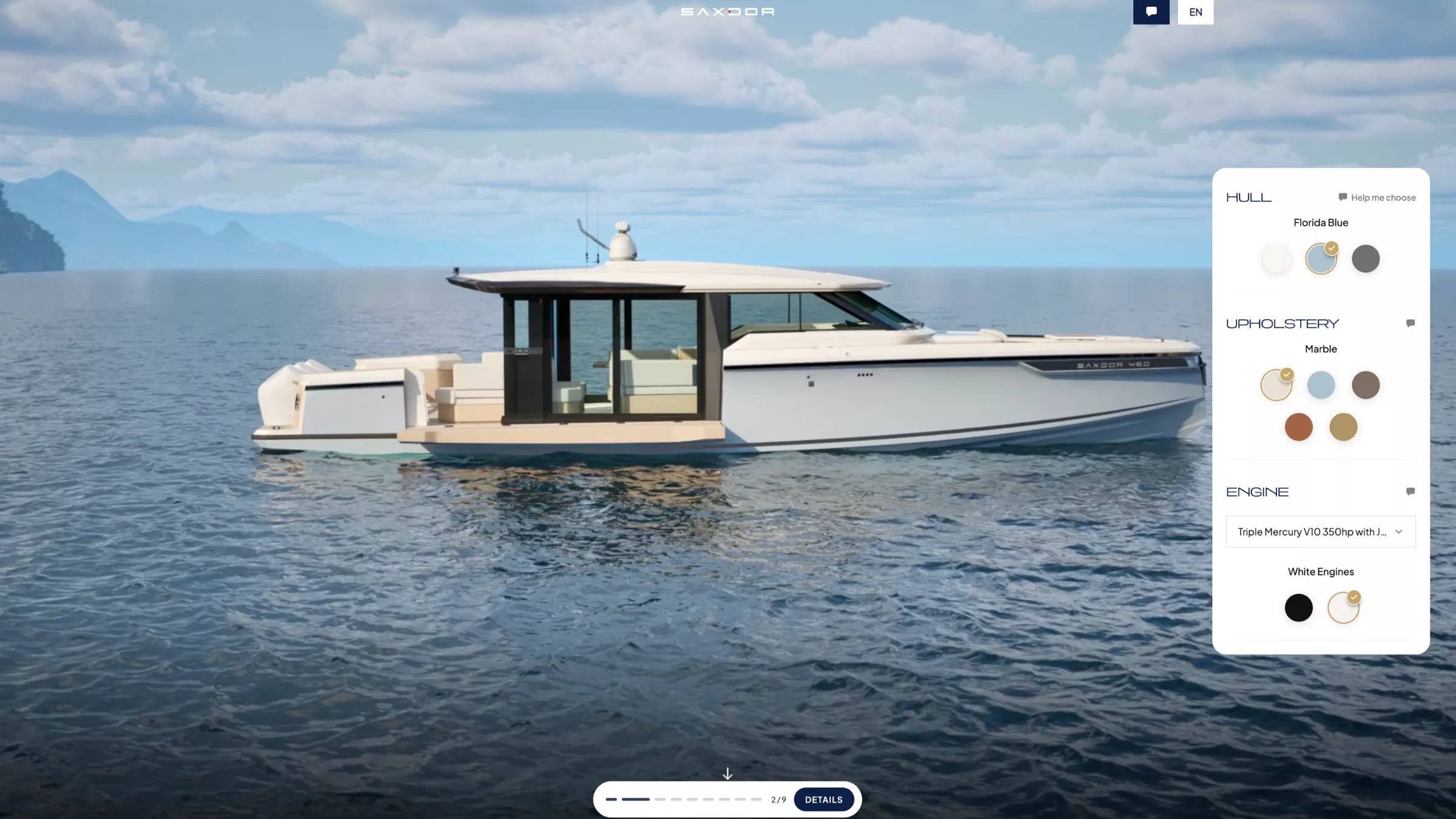
Configuration is woven into this journey rather than bolted on at the end. At key moments in the scroll, a configuration panel emerges naturally, inviting the buyer to make selections that are immediately reflected in the visuals. Choose a hull color and the product visuals update to reflect the change with the same photorealistic quality throughout. Pick an engine, select an upholstery, toggle an accessory package – each choice builds toward a product that feels personally curated rather than generically shown.
Throughout the Showroom experience, in relevant parts of the journey, a visual summary of the configured product is showcased, giving an overview of the configured product that creates balance from the focus on individual features on the configuration stages. When all the selections have been made and information displayed, we end the experience with a final summary animation of the product with a clear call to action – the users have already made most of the decision at this point. The CTA is the last step of the Showroom journey they've just been on, and at the same time, the first step towards ownership. Their configuration details route directly to the relevant dealer email or feed into an order management system, so the lead arrives with full context.
Why this matters for the purchase decision
In short, it’s the product fidelity that translates into trust – trust to make an informed decision with confidence. Most consumers researching a high-value product today face the same frustrating set of alternatives online: static product pages, PDF brochures, image galleries that show one or two sample configurations, or web configurators that kind of look like the real thing, but not quite. None of these give a buyer genuine confidence. They leave the research and dreaming phase feeling uncertain, needing to fill in too many blanks, or trying to climb their way out of an uncanny valley of traditional web 3D. This uncertainty creates hesitation that can leave the prospective buyer out of reach.
The Consumer Showroom is designed to close that gap. The quality bar for visuals is set deliberately high: the experience should feel like a premium product launch page, where every image is curated, every transition is intentional, and the product is always shown at its best. When the detail is high enough, buyers stop feeling like they're taking a chance and start feeling like they already know the product. That shift, from uncertainty to confidence, is what moves them from browsing to buying.
Always on, always available
A boat show like Cannes is exceptional for the people in that event, without a doubt. But it is a handful of days, in one city, for a fraction of the global market. The Consumer Showroom is open 24/7, in every market, presenting the full portfolio with no logistics required. It doesn't replace the magic of standing next to a beautiful yacht in the South of France – but it gives that experience to the millions of potential buyers who couldn’t make it there.
A Digital Twin is a photorealistic, interactive 3D replica of a physical product. It can be configured, explored, and presented in a virtual environment – accurately representing the real product's appearance, features, and options.
Every Saxdor model in the Digital Showroom exists as a Digital Twin. Buyers and dealers can explore each yacht, interact with its features, and configure it in real time – seeing every selection reflected instantly in high-fidelity 3D.
The Younite Virtual Showroom is the platform designed for manufacturers of complex, configurable products – vehicles, boats, machinery, equipment, and other variant-rich portfolios – who want to present their full range in an interactive, immersive environment that works across sales and marketing touch points. It works across devices and comes with a version directed towards sales representatives & dealers as well as one directed for the consumers.
The Younite Virtual Showroom is built for brands whose products are complex, high-value, and configurable – sectors such as, but not limited to, marine, automotive, heavy equipment, and industrial machinery. It benefits dealers who need to present a broad portfolio without physical inventory, and consumers who want to explore and personalize a product before purchasing.
A traditional product page presents static information. A 3D configurator typically walks a user through a configuration where visual quality is capped by the browser. A Virtual Showroom combines key components of both product marketing and configuration pages to a more comprehensive, elevated, product journey: it presents the products with engaging marketing visuals and provides a visually stunning configuration experience in a contextual environment.
The Business Showroom is optimized for the dealer or sales professional – built for presenting, demonstrating, and closing. The Consumer Showroom is designed for the end buyer browsing independently: it prioritizes discovery, emotional engagement, and guided exploration before directing the buyer toward a next step with a dealer. Business Showroom utilizes pixel streaming, while the Consumer Showroom utilizes dynamically combined pre-rendered visuals.
The ability to sell products before they physically exist, reduction in dependence on physical inventory for sales and marketing, a more consistent brand experience across all markets, and increased buyer confidence at the point of enquiry. The Virtual Showroom effectively extends the commercial impact of events like trade shows to a permanent, global, always-on channel.
Implementation time depends on the size and complexity of the product portfolio. In many cases, a functional Virtual Showroom can be deployed in approximately 5–8 weeks once the required product data and assets are available.
